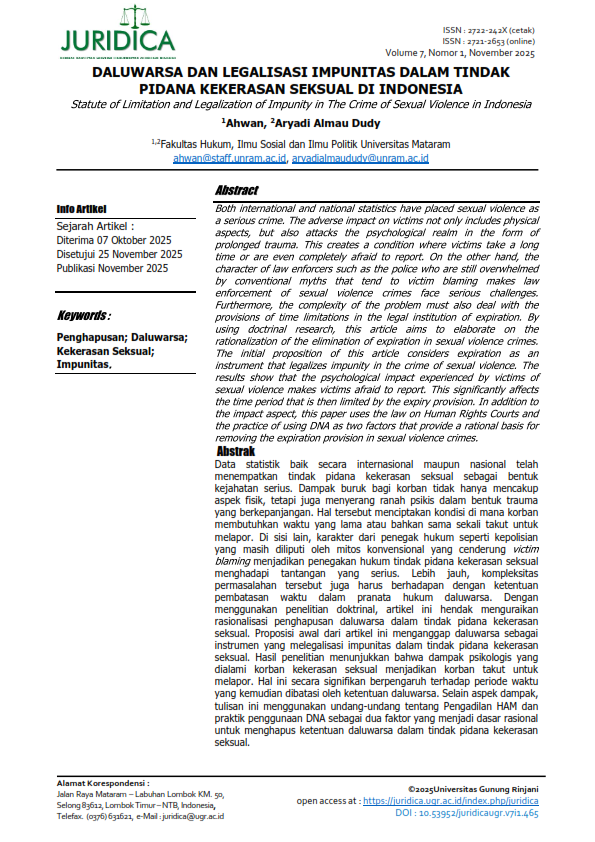
DALUWARSA DAN LEGALISASI IMPUNITAS DALAM TINDAK PIDANA KEKERASAN SEKSUAL DI INDONESIA
Statute of Limitation and Legalization of Impunity in The Crime of Sexual Violence in Indonesia
Keywords:
Penghapusan; Daluwarsa; Kekerasan Seksual; Impunitas.Abstract
Data statistik baik secara internasional maupun nasional telah menempatkan tindak pidana kekerasan seksual sebagai bentuk kejahatan serius. Dampak buruk bagi korban tidak hanya mencakup aspek fisik, tetapi juga menyerang ranah psikis dalam bentuk trauma yang berkepanjangan. Hal tersebut menciptakan kondisi di mana korban membutuhkan waktu yang lama atau bahkan sama sekali takut untuk melapor. Di sisi lain, karakter dari penegak hukum seperti kepolisian yang masih diliputi oleh mitos konvensional yang cenderung victim blaming menjadikan penegakan hukum tindak pidana kekerasan seksual menghadapi tantangan yang serius. Lebih jauh, kompleksitas permasalahan tersebut juga harus berhadapan dengan ketentuan pembatasan waktu dalam pranata hukum daluwarsa. Dengan menggunakan penelitian doktrinal, artikel ini hendak menguraikan rasionalisasi penghapusan daluwarsa dalam tindak pidana kekerasan seksual. Proposisi awal dari artikel ini menganggap daluwarsa sebagai instrumen yang melegalisasi impunitas dalam tindak pidana kekerasan seksual. Hasil penelitian menunjukkan bahwa dampak psikologis yang dialami korban kekerasan seksual menjadikan korban takut untuk melapor. Hal ini secara signifikan berpengaruh terhadap periode waktu yang kemudian dibatasi oleh ketentuan daluwarsa. Selain aspek dampak, tulisan ini menggunakan undang-undang tentang Pengadilan HAM dan praktik penggunaan DNA sebagai dua faktor yang menjadi dasar rasional untuk menghapus ketentuan daluwarsa dalam tindak pidana kekerasan seksual.
References
A. BUKU
Imwinkelried, Edward J. “The Relative Priority That Should Be Assigned ToTrial Stage DNA Issues.” In DNA and the Criminal Justice System, edited by David Lazer, 91–108. Cambridge, Massachusetts: The MIT Press, 2019. https://doi.org/10.7551/mitpress/2472.003.0009.
Robinson, Paul H, and Michael T Cahill. Law without Justice: Why Criminal Law Doesn’t Give People What They Deserve. Oxford University Press. New York: Oxford University Press, 2006. https://doi.org/10.5860/choice.43-5557.
Unicef. “When Numbers Demand Action: Confronting the Global Scale of Sexual Violence against Children,” 2024.
Budiarti, Arsa Ilmi, Gladys Nadya Arianto, and Marsha Maharani. “Data Dan Fakta Kekerasan Seksual Di Indonesia 2021.” Indonesia Judicial Research Society (IJRS), 2022, 52. http://ijrs.or.id/wp-content/uploads/2022/04/Data-dan-Fakta-Kekerasan-Seksual-di-Indonesia-2021-8-Apr-2022.pdf.
B. ARTIKEL JURNAL
Aequitas and Amy Jeanguenat. “Understanding the Use of John Doe Arrest Warrants in Cold Case Sexual Assaults for Prosecutors Responding to Defense Arguments,” 2015.
Alves, Ana Carolina, Maria Leitão, Ana Isabel Sani, and Diana Moreira. “Impact of Sexual Abuse on Post-Traumatic Stress Disorder in Children and Adolescents: A Systematic Review.” Social Sciences 13, no. 4 (2024). https://doi.org/10.3390/socsci13040189.
Campbell, Rebecca, and Sharon M. Wasco. “Understanding Rape and Sexual Assault: 20 Years of Progress and Future Directions.” Journal of Interpersonal Violence 20, no. 1 (2005): 127–31. https://doi.org/10.1177/0886260504268604.
“Criminal Procedure — Statutes of Limitations — South Africa Removes Statute of Limitations Distinction Between Rape and Other Sexual Offenses. — Levenstein v. Estate of Frankel 2018 (8) BCLR 921 (CC).” Harvard Law Review 132, no. 8 (2019): 2394–2401. http://search.ebscohost.com/login.aspx?direct=true&db=a9h&AN=137018602&site=ehost-live.
Dieterich, Mary Frances. “Criminal Law : Limitation of Prosecution - Time.” Land & Water Law Review 5, no. 1 (1970): 179–90.
Editors. “The Statute of Limitations in Criminal Law : A Penetrable Barrier to Prosecution.” University of Pennsylvania Law Review 102, no. 5 (1954): 630–53.
Fellmeth, Aaron X., and Maurice Horwitz. Guide to Latin in International Law. Guide to Latin in International Law. New York: Oxford University Press, 2009. https://doi.org/10.1093/acref/9780195369380.001.0001.
Flanders, Chad. “Time Death and Retribution.” Journal of Constitutional Law 2 (2019): 431–84.
Gallen, James. “Historical Abuse and the Statute of Limitations.” Statute Law Review 39, no. 2 (2018): 103–17. https://doi.org/10.1093/SLR/HMW045.
Goodman-Williams, Rachael, Jessica Volz, and Kathryn Fishwick. “Reasons for Not Reporting Among Sexual Assault Survivors Who Seek Medical Forensic Exams: A Qualitative Analysis.” Journal of Interpersonal Violence 39, no. 9–10 (2024): 1905–25. https://doi.org/10.1177/08862605231211926.
Jessica Shaw, Rebecca Campbell, Debi Cain, Hannah Feeney. “Beyond Surveys and Scales: How Rape Myths Manifest in Sexual Assault Police Records.” Psychology of Violence 7, no. 4 (2017): 602–14.
Jones, Jeffrey S., Carmen Alexander, Barbara N. Wynn, Linda Rossman, and Chris Dunnuck. “Why Women Don’t Report Sexual Assault to the Police: The Influence of Psychosocial Variables and Traumatic Injury.” Journal of Emergency Medicine 36, no. 4 (2009): 417–24. https://doi.org/10.1016/j.jemermed.2007.10.077.
Kitai-Sangero, Rinat. “Between Due Process and Forgiveness: Revisiting Criminal Statutes of Limitations.” Drake Law Review 61 (2013): 423–46.
Malveaux, Suzette M. “Statutes of Limitations: A Policy Analysis in the Context of Reparations Litigation.” George Washington Law Review 74, no. 1 (2005): 68–122.
McPherson, Lynne, Kathomi Gatwiri, Anne Graham, Darlene Rotumah, Kelly Hand, Corina Modderman, Jaime Chubb, and Samara James. What Helps Children and Young People to Disclose Their Experience of Sexual Abuse and What Gets in the Way? A Systematic Scoping Review. Child and Youth Care Forum. Vol. 54. Springer US, 2025. https://doi.org/10.1007/s10566-024-09825-5.
Murphy, Erin. “DNA in the Criminal Justice System: A Congressional Research Service Report* (*From the Future).” UCLA Law Review 340, no. 2016 (2016): 340–71.
Murphy, Jeffrie G. Getting Even: Forgiveness and Its Limits. Oxford University Press. New York, 2003. https://doi.org/10.1093/acprof:oso/9780195178555.001.0001.
Oliver Wendell Holmes, Jr. “The Path of the Law.” Harvard Law Review 457 (1897): 194–96. https://doi.org/10.4324/9780203077702-16.
Shinton, Symone. “Pedophiles Don’t Retire: Why the Statute of Limitations on Sex Crimes Against Children Must Be Abolished.” Chicago-Kent Law Review 92, no. 1 (2017): 317.
Stallybrass, W.T.S. “A Comparison of the General Principles of Criminal Law in England with the " Progetto Definitivo Di Un Nuovo Codice Penale of Alfredo Rocco IV.” Journal of Comparative Legislation and International Law 13, no. 4 (1931): 203–15.
Swanson, Paul D. “Limitless Limitations: How War Overwhelms Criminal Statutes of Limitations.” Cornell Law Review 97, no. 6 (2012): 1557–85.
“The Statute of Limitations in a Criminal Case : Can It Be Waived ?” William & Mary Law Review 18, no. 4 (1977).
The United States District Court For The District of, and Columbia. United States v. Marion (1971).
Titus, Diljeet, Rai S Mittal, Ankur Manchanda, and Lorenzo Mulazzi. “Statute of Limitation for Criminal Prosecution in India.” DPCE Online 4 (2021).
Tomlin, Patrick. “Time and Retribution.” Law and Philosophy 33, no. 5 (2014): 655–82. https://doi.org/10.1007/s10982-013-9196-z.
“Toussie v. United States 397 U.S. 112,” 1970.
Vogler, Richard. “Why Is There No Statute of Limitations for Criminal Cases in England and Wales ?” DPCE Online 49, no. 4 (2021): 3907–22.
Weiss, Karen G. “Too Ashamed to Report: Deconstructing the Shame of Sexual Victimization.” Feminist Criminology 5, no. 3 (2010): 286–310. https://doi.org/10.1177/1557085110376343.
C. Peraturan Perundang-Undangan
Republik Indonesia. “Undang-Undang Republik Indonesia Nomor 1 Tahun 2023 Tentang Kitab Undang-Undang Hukum Pidana,” 2023.
———. UU RI Nomor 26 Tahun 2000 Tentang Pengadilan HAM (2000).
D. Internet
Anita Permata Dewi. “Banyak Korban Kekerasan Seksual Butuh Waktu Lama Melapor.” Antara News, 2024. https://www.antaranews.com/berita/3987705/banyak-korban-kekerasan-seksual-butuh-waktu-lama-melapor.
Biro Humas dan Umum Kementerian Pemberdayaan Perempuan dan Perlindungan Anak. “Menteri PPPA: Banyak Perempuan Dan Anak Korban Kekerasan Tidak Berani Melapor,” 2025. https://www.kemenpppa.go.id/siaran-pers/menteri-pppa-banyak-perempuan-dan-anak-korban-kekerasan-tidak-berani-melapor.
Bobbi Nodell. “75% of Sexual Assault Survivors Have PTSD One Month Later.” UW Medicine, 2021. https://newsroom.uw.edu/news-releases/75-sexual-assault-survivors-have-ptsd-one-month-later.
Fatimatuz Zahra. “UU TPKS Berlaku, Mengapa Korban Kekerasan Seksual Belum Juga Aman?” Tirto.id, 2022. https://tirto.id/uu-tpks-berlaku-mengapa-korban-kekerasan-seksual-belum-juga-aman-gtAv.
Folmar, Chloe. “Biden Signs Bill Eliminating Civil Statute of Limitations for Child Sex Abuse Victims.” The Hill, 2022. https://thehill.com/homenews/administration/3647958-biden-signs-bill-eliminating-civil-statute-of-limitations-for-child-sex-abuse-victims/?fbclid=IwAR2QGgei5vyUtQw2qeA4XPd9XuKN2ssUdIVhcQkd6nw-jtiLcONRCh-Nim8&mibextid=ZdgOX5.
Kyle Dillon Hertz. “It’s Time to End Statute of Limitations Laws for Child Sex Abuse Victims. For Good.” Time, 2024. https://time.com/6963436/ending-statute-of-limitations-laws-child-sex-abuse-victims/.
Permata Adinda. “Kenapa Korban Kekerasan Seksual Enggan Melaporkan Kasusnya?” Asumsi, 2021. https://asumsi.co/post/58809/kenapa-korban-kekerasan-seksual-enggan-melaporkan-kasusnya/.
Redaksi. “Kadaluarsa! Penyelidikan Kasus Dugaan Kekerasan Seksual Eks Dekan UIR.” Media Lokal.co, 2024. https://medialokal.co/news/detail/56761/kadaluarsa-penyelidikan-kasus-dugaan-kekerasan-seksual-eks-dekan-uir.
SIMFONI-PPA. “Data Kekerasan Seksual Di Indonesia 2025.” Kementerian Pemberdayaan Perempuan dan Perlindungan Anak, 2025. https://kekerasan.kemenpppa.go.id/ringkasan.
The Conversation. “Kasus KPI: Potret Abainya Aparat Pada Korban Kekerasan Seksual Di Indonesia.” The Conversation, 2021. https://theconversation.com/kasus-kpi-potret-abainya-aparat-pada-korban-kekerasan-seksual-di-indonesia-168666.
Universitas Muhammadiyah Yogyakarta. “Apabila Tak Cukup Bukti, Korban Pelecehan Seksual KPI Bisa Kena Serangan Balik.” Universitas Muhammadiyah Yogyakarta, 2021. https://www.umy.ac.id/apabila-tak-cukup-bukti-korban-pelecehan-seksual-kpi-bisa-kena-serangan-balik/.
Published
How to Cite
Issue
Section
Copyright (c) 2025 Ahwan, Aryadi Almau Dudy

This work is licensed under a Creative Commons Attribution-NonCommercial-ShareAlike 4.0 International License.